
Is Your Website Ready for AI?
Search is changing. People aren't just Googling businesses anymore. They're asking AI who they should use. The question is whether AI understands your business well enough to recommend you.
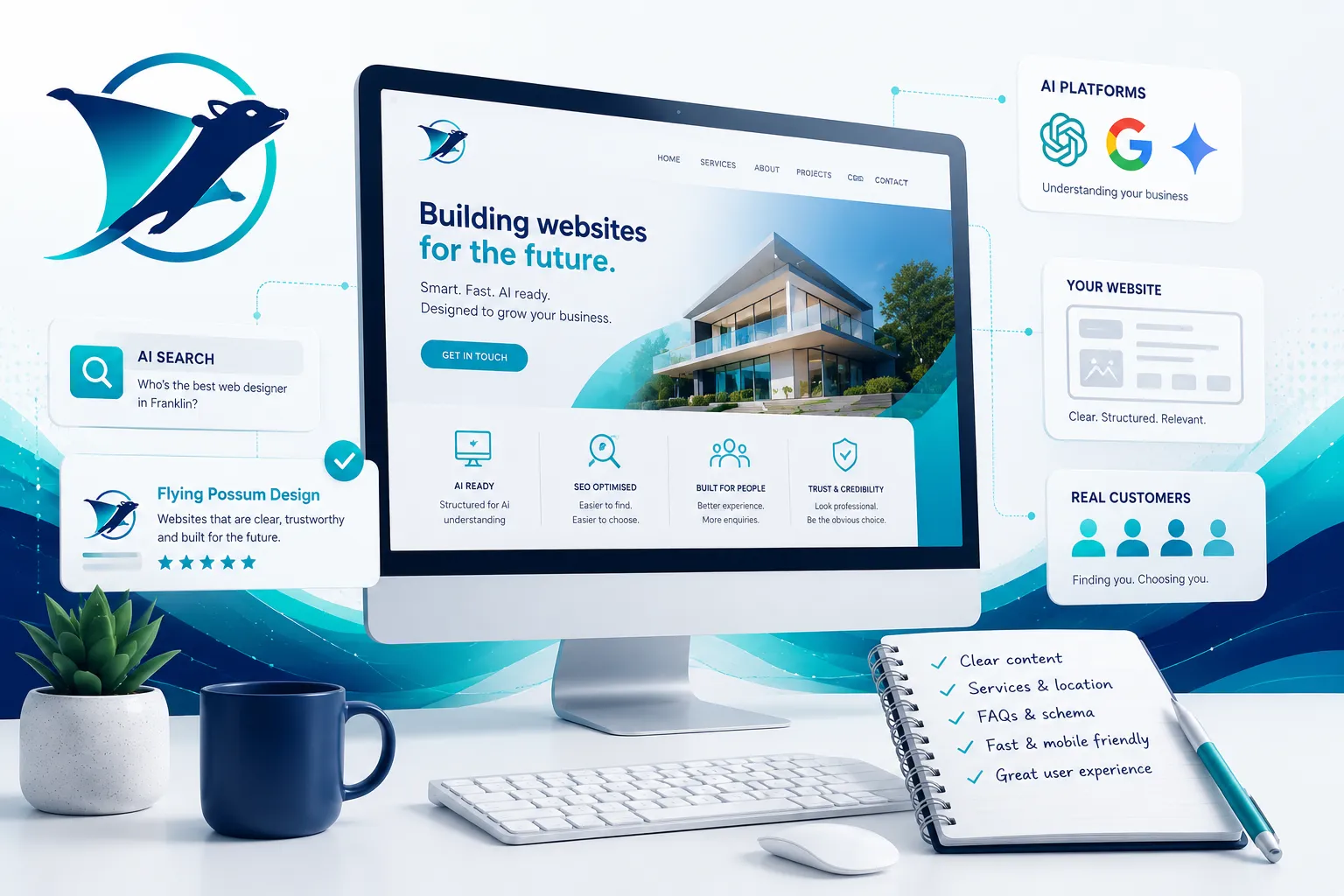
Will AI understand your website well enough to recommend your business?
A few years ago, everyone just Googled it.
If someone needed a plumber, accountant, landscaper, mortgage adviser or web designer, they generally did one thing.
They Googled it.
That is changing.
People are increasingly asking AI things like:
Instead of always being given a page full of links, AI can increasingly give people a direct answer.
Sometimes even a recommendation.
Which creates a fairly important question for every business owner.
Does your website give AI enough information to properly understand what your business actually does?
This isn't about sticking AI everywhere.
There is already enough rubbish being written about AI.
You don't need dancing robots on your homepage.
You don't necessarily need an AI chatbot.
And you certainly don't need to rebuild your entire business around artificial intelligence.
What you do need is a website that makes it incredibly easy for Google, AI platforms and — most importantly — your customers to understand who you are, what you do, where you do it, who you help and why they should choose you.
That sounds pretty obvious.
Unfortunately, plenty of websites still don't do it very well.
AI can't recommend what it can't understand.
A human can often work out what a business does from a vague homepage, a few photos and some clever marketing language.
Machines are less forgiving.
Fantastic.
But what do you actually do?
Are you an accountant?
A builder?
A software company?
Do you sell garden sheds?
AI systems need context.
That means your website needs clear language around your real services, the areas you work in, your experience and the type of customers you help.
You can still have personality.
In fact, you should.
But somewhere on the page we need to tell both humans and machines exactly what you do.
Your website needs structure behind the scenes too.
This is where things get slightly more technical — but not scary technical.
Modern websites can provide useful information behind the scenes that helps search engines and other platforms understand the business.
Schema Markup
This helps identify things such as your business, services, location, articles, FAQs and other useful information.
Good Page Structure
Proper headings make it much clearer what each page and section is actually about.
Dedicated Service Pages
Instead of squeezing fifteen services onto one page, the important ones deserve enough information to properly explain them.
Consistent Business Information
Your website, Google Business Profile and other online listings should all agree about who you are and where you operate.
And then there's the human at the other end.
This bit often gets lost in conversations about AI.
Your website still has to work for people.
In fact, I think that becomes even more important.
Imagine AI recommends your business.
Brilliant.
The potential customer clicks through to your website.
It takes forever to load.
They can't immediately tell what you do.
It looks terrible on their phone.
Your latest news article is from 2019.
And your phone number is hiding somewhere in the footer.
You've just done the hard bit and been found — only to lose them when they arrive.
Technology changes.
People don't change quite as quickly.
So, what does an AI-ready website actually look like?
It isn't a particular style of website.
There is no special AI button.
For most businesses, it's simply a combination of some fairly sensible things done properly.
Clear Homepage
Your homepage should immediately explain what you do.
Proper Service Pages
Important services deserve enough information to be understood.
Clear Location
If you work in Auckland, Franklin, Waikato or nationwide, say so.
Real FAQs
Answer the actual questions your customers ask.
Technical SEO
Titles, descriptions, headings, schema and indexing still matter.
Google Business
Your Google Business Profile should support what the website says.
Real Expertise
Real projects, advice, photos and experience beat generic waffle.
Experience may actually matter more, not less.
This is one of the reasons I'm excited about AI.
There has been plenty of discussion about AI replacing designers, marketers, developers and writers.
I think there's another side to it.
When everyone can produce content at the push of a button, real experience becomes easier to spot.
Anyone can ask AI to write an article about building a retaining wall.
But the landscaper who has spent fifteen years fixing badly built retaining walls knows things AI doesn't.
The accountant who has dealt with hundreds of small businesses knows what actually goes wrong.
The electrician who has been on thousands of job sites knows which shortcuts come back to bite people.
That knowledge should be on your website.
AI can help organise it.
AI can help communicate it.
But the expertise still comes from you.
Your website isn't disappearing. It's becoming more important.
I don't believe websites are disappearing.
Quite the opposite.
Your website is becoming an increasingly important source of information about your business online.
Google uses it.
AI platforms can use information published online.
And customers certainly use it to decide whether they trust you.
That means your website can't just be a digital brochure anymore.
It needs to become the clearest and most trustworthy source of information about your business online.
That's what I mean when I talk about an AI-ready website.
The tools change. Good marketing doesn't.
I've been designing for more than 30 years and running Flying Possum for 23 of them.
Every few years someone announces that the latest piece of technology is going to make websites, designers or marketing agencies obsolete.
It hasn't happened yet.
What does happen is that the tools change.
And the businesses that adapt generally get ahead.
AI is the next big change, and I'm spending a lot of time working out how it can genuinely help my clients rather than jumping on every shiny new AI gadget that appears.
For me, an AI-ready website isn't about chasing technology.
It's about making your business easier to find, easier to understand and easier to choose.
That was good marketing 20 years ago.
It still is.

Flying Possum Design
Services Enquiry Assistant