
Five Things Every Business Website Should Have in 2026
A good website doesn't need every new trick. It needs to explain your business clearly, show people why they should trust you and make becoming a customer easy.
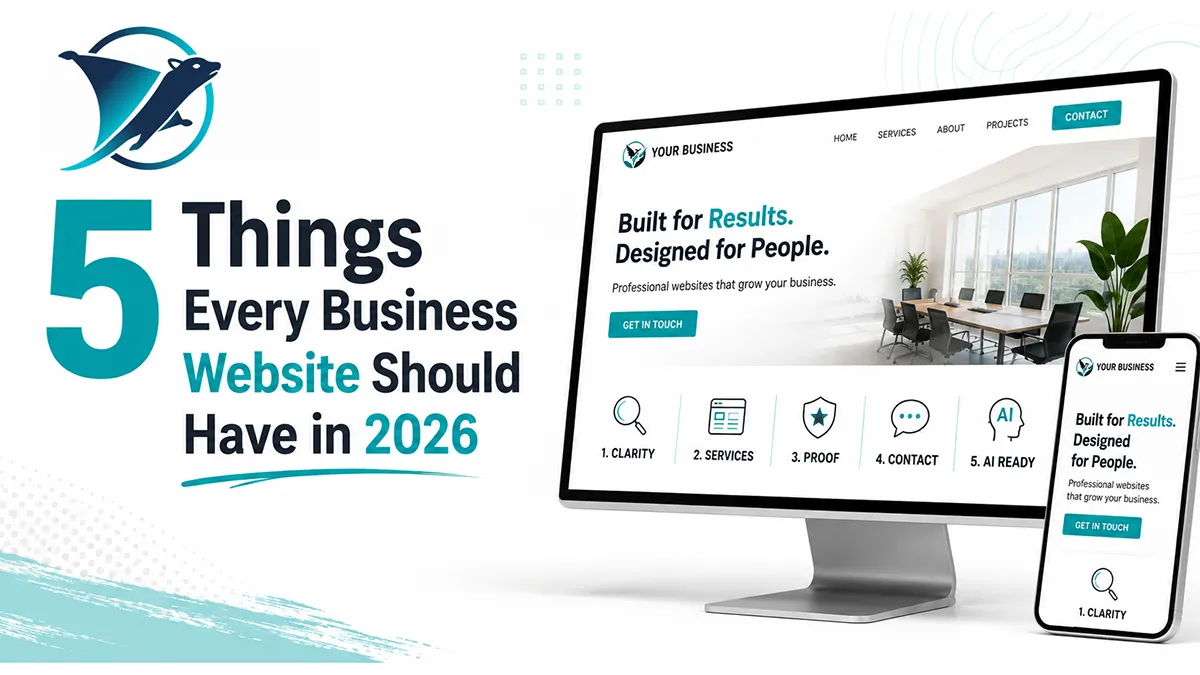
Your website doesn't need to do everything. It just needs to do the important things really well.
Website technology changes. What customers need from a website really doesn't.
I've been building websites for Kiwi businesses for a long time, and I've watched plenty of trends come and go.
Flash websites. Full-screen sliders. Mobile-first design. Online booking. Social media. Google updates. AI.
The technology keeps moving.
But underneath all of it, the job of a business website is still pretty simple.
Explain what you do.
Give people confidence that you can do it.
And make the next step easy.
In my last article, Why Your Competitor Might Be Getting More Enquiries — Even With a Worse Website , I talked about why the prettiest website doesn't always win.
This time, let's look at what I'd actually want every business website to get right in 2026.
Tell people what you do before they have to figure it out.
This sounds ridiculously obvious.
Yet plenty of websites still open with something like:
Sounds impressive.
I still have no idea what the business actually does.
Within a few seconds, your homepage should tell me:
You can add personality afterwards.
Clarity first.
Give your important services proper space.
One generic Services page isn't always enough.
If you offer five genuinely different services and want customers to find each of them, give those services something worth finding.
A proper service page lets you explain:
What the service actually involves.
Who it's suitable for.
The problems it solves.
What your process looks like.
And why somebody should choose you.
This is something I build into business websites whenever the service mix justifies it.
Don't create pages just to make the website bigger.
Create them because customers genuinely need the information.
Give people a reason to believe what you're telling them.
Every business says they're professional.
Reliable.
Experienced.
Customer focused.
That's fine.
But what actually convinces somebody?
Depending on the business, that might also mean before-and-after photos, case studies, client names, qualifications, accreditations or video.
Your website should help answer that before they ever pick up the phone.
Make becoming a customer easy.
This is bigger than simply having a Contact page.
Think about what somebody has to do from the moment they arrive until the moment they enquire.
Can they navigate the website easily?
Can they use it comfortably on a phone?
Can they find a phone number without digging through the footer?
Is the form sensible?
Do they know what happens after they submit it?
You don't need six pop-ups, three flashing buttons and a chatbot attacking somebody before they've read the first paragraph.
Just make the logical next step really easy.
Make sure the website works properly behind the pretty bits.
This is the stuff customers may never consciously notice.
But they'll certainly notice when it's bad.
A good business website in 2026 should have a solid technical foundation.
This is where traditional SEO and newer AI-ready website thinking start to overlap.
Search engines and AI tools need to clearly understand who you are, what you do, where you operate and why your business is credible.
But none of that technical work rescues a confusing website.
That's still the approach I'd take.
You don't need every new website trick.
There will always be something new.
Another animation.
Another plugin.
Another AI tool.
Another “must-have” feature.
Most businesses don't need everything.
They need the right things working properly.
Full of clever features.
Animations everywhere. Pop-ups. Chat widgets. Vague brand language. Huge image files.
Looks impressive, but customers still have to work out what the business actually does.
Clear, useful and easy to trust.
Clear services. Real work. Good mobile experience. Easy contact. Strong technical foundation.
That's the website I'd expect to work harder for the business.
Maybe. But not necessarily.
I'm a web designer, so you'd probably expect me to tell you the answer is always yes.
It isn't.
Sometimes I look at an older website and the bones are perfectly good.
It might just need clearer content.
Better service pages.
New project photos.
Stronger calls to action.
Or some technical work behind the scenes.
Other times, the platform, structure or design has simply reached the end of the road and starting again makes more sense.
The objective shouldn't really be:
“I want a new website.”
It should be:
“I want my website to do a better job for my business.”
That's a much better place to start.
A good website should make your business easier to understand and easier to choose.
I'm a designer, so yes — I want websites to look good.
But good design isn't decoration.
It has a job.
It should guide people.
It should make information easier to understand.
It should make the business feel credible.
And it should help somebody take the next step without having to think too hard about it.
That's why I'm not particularly interested in chasing every new digital trend just because it's new.
Get the fundamentals right first.
Then use technology — including AI — where it genuinely makes the website better.
Not because it's fashionable.
Because it actually helps.
Not sure whether your website is actually doing its job?
Open your homepage and pretend you've never seen the business before. Can you tell what it does? Can you find the main services? Can you see real evidence? Is it easy to enquire?
Send me the website and I'll tell you what I think is working, what I'd change first and whether I think you genuinely need a rebuild — or just need to make the website you've already got work harder.
Ask Jason to Review My Website