
Do You Actually Need a New Website — or Does Your Old One Just Need Fixing?
An older website isn't automatically a bad website. Sometimes a few sensible changes can give it years more life. Other times, you're just throwing good money after bad.
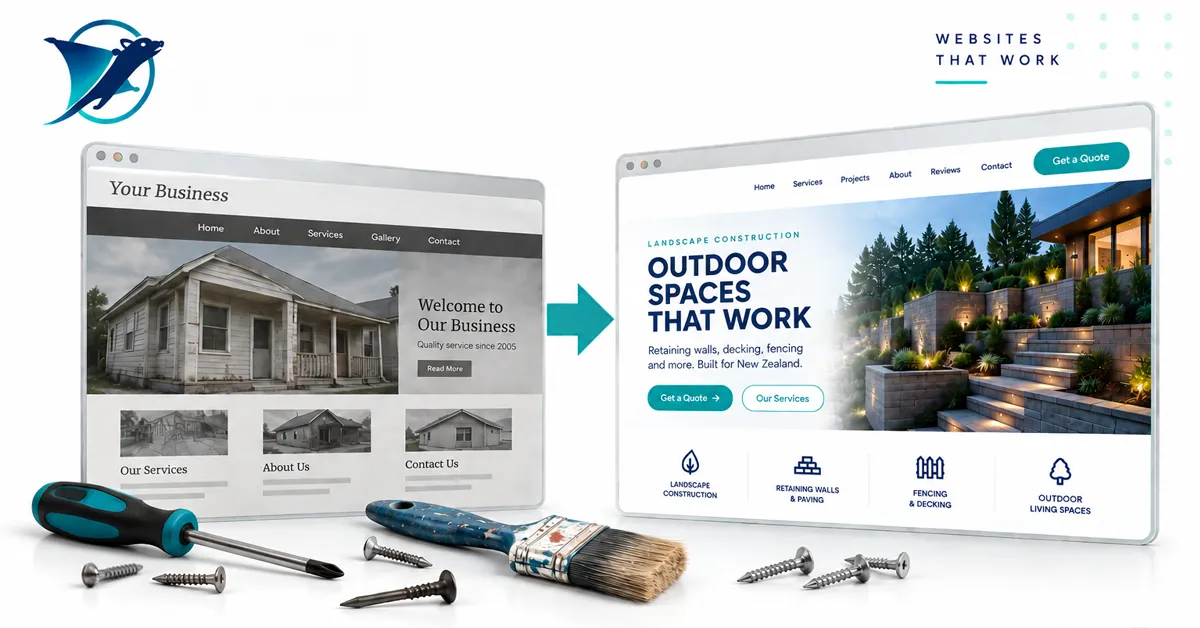
I'm a web designer, so you'd probably expect me to say
“Of course you need a new website.”
I don't.
Don't replace a website just because it's old.
I've worked on enough websites over the years to know that age isn't actually the best way to judge one.
I've seen older websites that are still doing a perfectly good job.
And I've seen relatively new ones that look impressive but are confusing, slow, difficult to update and don't generate much at all.
So when somebody comes to me and says, “Jason, I think I need a new website,” that's not really the first question I'm interested in.
I want to know:
Because if we can identify that, we can make a much better decision about whether to fix it, rebuild it or simply leave the bloody thing alone.
In Five Things Every Business Website Should Have in 2026 , I looked at the fundamentals I think a good business website needs.
This time, let's use those fundamentals to decide whether the website you've already got is worth saving.
The bones are good. The website just needs some attention.
This is probably more common than people think.
The website might be built on a perfectly decent WordPress setup. It works on mobile. The pages load reasonably well. The structure makes sense and there's nothing fundamentally broken underneath it.
It just looks tired.
Or the business has changed and the content hasn't kept up.
Maybe the service pages are too thin, the photos are ancient, the calls to action are weak or the homepage no longer explains what the company has become.
Those are often fixable problems.
Sometimes a targeted website upgrade is the smarter investment.
Sometimes patching the old website stops making sense.
There is a point where “just fixing a few things” turns into constantly fighting the website.
Every small change creates another problem.
The theme is ancient.
Plugins haven't been maintained.
Nobody remembers how half of it was built.
Mobile has been bolted on as an afterthought.
And adding one new service somehow turns into half a day's work.
That's when I'd start seriously looking at a rebuild.
Especially if you're going to end up rebuilding it six months later anyway.
That's when starting again can actually be the cheaper decision.
How does the website actually feel to use?
Business owners naturally look at their own website differently from customers.
You know where everything is.
You know what all the industry terminology means.
You know which service somebody needs.
Your customer doesn't.
Try using the website as if you know absolutely nothing about the business.
This is also why I don't judge a website purely on how pretty it looks.
As I covered in Why Your Competitor Might Be Getting More Enquiries — Even With a Worse Website , a less attractive website can still outperform yours if it's easier for customers to understand and use.
A website can look fine and still have problems underneath.
This is the part most business owners shouldn't really have to worry about.
But somebody should.
An older website may have accumulated years of plugins, old code, abandoned pages, redirects, giant images and various bits added by different people at different times.
It can still look perfectly normal from the front.
Underneath, it can be a dog's breakfast.
And yes, this now includes making sure modern search and AI systems can clearly understand the business.
That's what I mean when I talk about an AI-ready website .
It doesn't mean stuffing the site full of AI.
It means making the information clear, structured and accessible enough that both people and machines can make sense of it.
Sometimes the right answer is: don't touch it.
This option doesn't get talked about enough.
If your website still represents the business properly, works well on phones, is technically healthy and consistently generates the sort of enquiries you want...
Why are we rebuilding it?
Because somebody said websites should be replaced every three years?
Because another business has a fancy animation?
Because you're bored with it?
None of those are particularly good business reasons.
Keep it maintained.
Keep the content current.
Add useful information when it's needed.
And spend the money somewhere else until there's a genuine reason to change it.
Fix it, rebuild it or leave it alone?
There's no magic age where a website suddenly expires.
I'd make the decision based on what the website is doing for the business — and how much work is required to make it do that job better.
Good foundation. Weak execution.
The platform and structure are sound, but the content, imagery, services, calls to action or search setup need work.
You're fighting the website.
The technology, structure, design or functionality is holding the business back and fixing it piecemeal no longer stacks up.
It's doing exactly what you need it to do.
Maintain it, keep the information current and don't spend money fixing a problem you don't actually have.
I'd rather fix the right problem than sell you the wrong solution.
Obviously I build websites.
I like building websites.
And sometimes a complete rebuild is absolutely the right answer.
But I don't think every conversation needs to start there.
If your existing website has a good foundation and we can make it considerably better without starting again, I'll tell you.
If I think you're going to waste money continually patching something that's reached the end of its useful life, I'll tell you that too.
And if I think the website is perfectly fine?
I'll tell you to leave the bloody thing alone.
The objective isn't to build you a new website.
The objective is to make sure the website you've got is doing a good job for your business.
Send me your website. I'll tell you what I'd do.
If you're wondering whether your website needs a few sensible improvements or a complete rebuild, send me the link.
I'll have a look at the design, content, structure and general setup and give you a practical opinion on where I'd spend the money first.
Ask Jason to Review My Website